
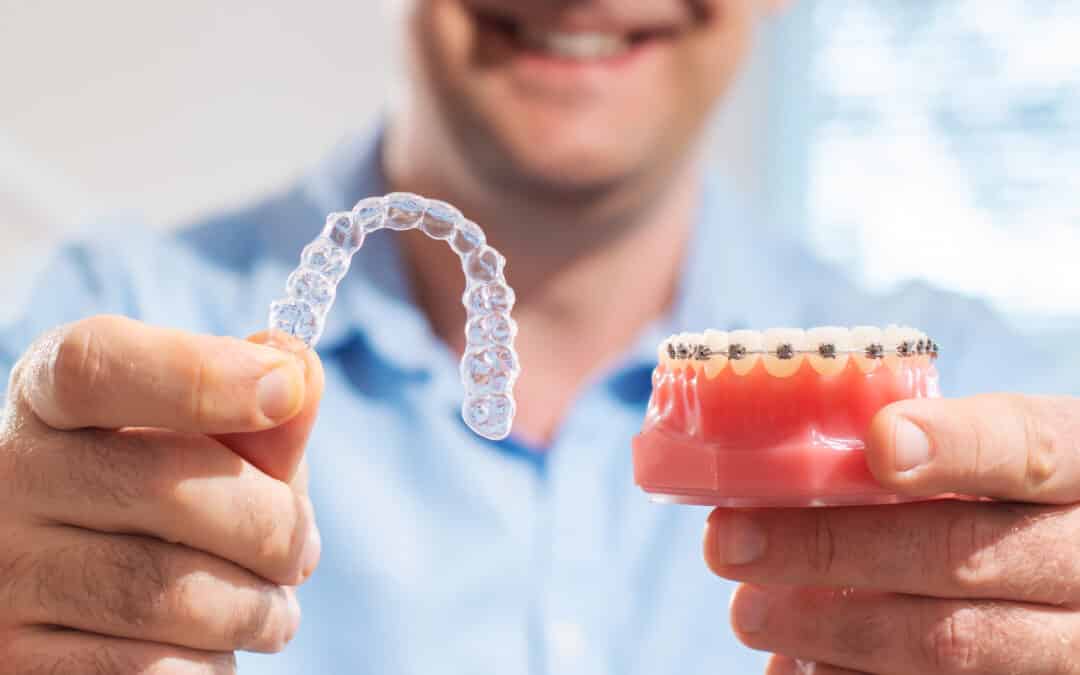
If you’re trying to choose between clear aligners vs braces, you’re probably weighing two things at once: how your teeth will look during treatment, and whether the option you pick will actually finish the job. Here’s the short answer. Both can straighten teeth well, and the right choice depends mostly on what your bite needs, how complicated the tooth movements are, and how consistently you can wear a removable appliance. For mild to moderate crowding or spacing, aligners are often a great fit. For bigger bite corrections, braces usually give the orthodontist more control.
Both options move teeth the same basic way, with steady, light pressure that lets the bone around each root reshape as the tooth shifts. Braces do it with brackets bonded to the teeth and a wire that the orthodontist changes over time. Aligners do it with a series of custom plastic trays, each one shaped a little differently from the last, often paired with small tooth-colored bumps called attachments that give the trays something to grip. The difference that matters most is who’s in control day to day. Braces work around the clock whether you think about them or not. Aligners only work while they’re in your mouth, which the American Association of Orthodontists puts at a minimum of 22 hours a day.
Getting this decision right at the start can save you months. An aligner case that stalls because the planned movements were too much for plastic trays can mean extra rounds of refinement trays, while someone who would have been happy in aligners may spend two years in brackets they didn’t need. At Eversmile Orthodontics, Dr. Ryan Davis is a board-certified orthodontist who offers Invisalign, Spark, Damon Ultima braces, and ceramic braces, so his recommendation isn’t tied to whichever system an office happens to carry. He plans each case around a stable bite, balanced facial features, and lifelong retention. That means he’s looking past straight teeth to whether the result will hold up for decades.
This Article Will Address
- How aligners and braces each move teeth
- What research says about results with each one
- Bite problems that usually call for braces
- How each option fits meals, school, work, and sports
- What affects cost and how payment works
- What Dr. Davis looks at before recommending one
What Is the Difference Between Aligners and Traditional Braces?
The biggest difference is that braces are fixed to your teeth and aligners are removable. Nearly everything else follows from that one fact, from what you can eat to how much control the orthodontist has over each tooth. Here’s how it plays out:
- Braces stay on 24 hours a day until the orthodontist takes them off, while aligners come out for meals and brushing and go back in for at least 22 hours.
- Braces move teeth as the wire is changed at each visit, while aligners move them as you switch to the next tray in your series.
- Metal brackets are easy to spot, tooth-colored brackets blend in, and aligners are close to invisible.
- Braces come with a list of foods to skip, like hard, sticky, and chewy snacks, while aligners have no food rules as long as you brush before putting them back in.
- Cleaning around brackets takes extra time and tools, while aligner patients brush and floss normally and also clean the trays.
Braces also come in more than one style. Damon Ultima braces use self-ligating brackets that hold the wire with a built-in clip instead of elastic ties, and ceramic braces trade metal brackets for tooth-colored ones that are much harder to notice in photos.
Are Invisalign and Spark Aligners as Effective as Braces?
For many cases, yes, but braces are still more dependable for certain kinds of tooth movement. A 2019 systematic review in BMC Oral Health compared patients treated each way and found that both corrected bite and alignment problems, and the aligner patients in those studies finished sooner on average. The same review found braces did better at a few specific jobs: settling the back teeth into solid contact, controlling the angle of the roots, replace with pulling teeth up or down, and holding results afterward.
That matches what orthodontists see in the chair. Aligners handle mild crowding, small gaps, and front-tooth alignment very well. They have a harder time pulling a tooth down into place, turning a rounded tooth like a lower premolar, or shifting the whole bite forward or back, because a plastic tray can only push on surfaces it can grip. Attachments and rubber bands close a lot of that gap. Dr. Davis plans clear aligner treatment with those limits in mind, and if your case is likely to fight the trays, he’ll tell you at the consultation instead of halfway through treatment. Between visits, Dental Monitoring gives him a regular look at how your teeth are tracking, so a stubborn tooth gets addressed early.
Who Is a Better Candidate for Braces Than Aligners?
Braces tend to be the better choice for people with complex bite problems, for younger kids, and for anyone who knows a removable tray would spend too much time in a pocket or backpack. Situations where braces often come out ahead include:
- A deep bite, open bite, or large overbite or underbite that needs the upper and lower teeth coordinated
- Teeth that are badly rotated, especially rounded premolars and canines
- A tooth that has to be pulled down into position, such as a canine that came in high
- Cases that involve removing teeth and closing the large spaces left behind
- Kids and young teens who are likely to lose trays or leave them out
None of these is an automatic rule. Plenty of teens do great with aligners, and some moderate bite cases respond well to aligners combined with rubber bands. And when the upper jaw is narrow, expansion may come first, whether that’s a palatal expander for a growing child or skeletal expansion for an adult, before either braces or aligners take over.
How Do Aligners and Braces Fit Into Everyday Life?
Aligners are easier to live with if you’re disciplined about wearing them, and braces are easier if you’d rather not think about treatment at all. With aligners, you take the trays out for every meal and every drink besides plain water, then brush before putting them back in. That’s simple on a normal workday and harder on a road trip, during a tournament weekend, or for anyone who snacks all afternoon. A tray left in a napkin at a restaurant can set progress back too.
Braces take those decisions off your plate, but they add a few of their own. Popcorn, hard candy, caramel, and corn on the cob go on hold, and flossing usually means a threader or a water flosser. Athletes wear a mouthguard over the brackets. Some aligner wearers notice a slight lisp for the first few days, which usually fades quickly. As for appointments, aligner patients at Eversmile typically come in every 8 to 12 weeks, and Dental Monitoring covers the time in between. You take quick scans of your teeth at home with your smartphone, and Dr. Davis’s team reviews them to confirm each tooth is moving the way your treatment plan calls for. If a tooth starts falling behind or a tray isn’t seating fully, they can catch it early and adjust, instead of finding out at your next visit weeks later.
Is There a Cost Difference Between Aligners and Braces?
Usually not much. The fee for either option depends mainly on how complex your case is and how long treatment will take, not on the appliance by itself. Many dental plans with orthodontic coverage apply that benefit the same way whether you choose braces or aligners, so it’s worth checking your plan before you assume one option is out of reach. At Eversmile, the payment side works the same for both:
- The first consultation is free
- Monthly plans run through 0% interest in-house financing
- HSA, FSA, ACH, and major credit cards are accepted
- Insurance from Delta Dental, Cigna, MetLife, Select Health, PEHP, and many other carriers is accepted
How Do Orthodontists Decide Which Option Is Best?
An orthodontist decides by matching the tooth movements your bite needs to the appliance that can deliver them reliably, then weighing that against your schedule and preferences. At Eversmile, that starts with a digital scan, X-rays, and an exam of how your teeth meet. Dr. Davis looks at the size and shape of your arches, how your jaws line up, how your front teeth sit relative to your lips and face, and whether a narrow palate could be affecting breathing. He also thinks ahead to retention, since a result that drifts after the retainer goes in isn’t much of a result.
From there, the answer usually falls into one of three groups. Some cases clearly call for braces, some are ideal for aligners, and many could go either way. When both would work well, the choice comes down to which one fits your life. You can look through all of Eversmile’s orthodontic treatment options ahead of time so you know what to ask about.
Now Booking Free Aligner and Braces Consultations at Eversmile
If you’re still torn between aligners and braces, a consultation is the quickest way to settle it. At Eversmile Orthodontics, your first visit is free, and you’ll leave knowing which option fits your bite and why. We’re welcoming new patients now, and our team is happy to answer questions before you commit to anything. Call 801.254.2700 or request your consultation online with an orthodontist in South Jordan, UT who offers both options under one roof.
Sources
- Which Orthodontic Treatment Is Best for You? (American Association of Orthodontists)
- A Comparison of Treatment Effectiveness Between Clear Aligner and Fixed Appliance Therapies (BMC Oral Health)
- Clear Aligners: Purpose and Types (Cleveland Clinic)

Dr. Ryan Davis
Ryan Davis is a Board Certified Orthodontist dedicated to creating healthy, confident smiles that are built to last. As the founder of the Utah Airway Study Club and a board member of the Utah Association of Orthodontists, he brings advanced training, personalized care, and a strong focus on facial harmony, function, and long-term stability to every patient’s smile journey.